

Can Words Harm?
My new measure that sparked Twitter outrage

How much do you agree with the following statements on a scale from 1 (strongly disagree) to 100 (strongly agree)?
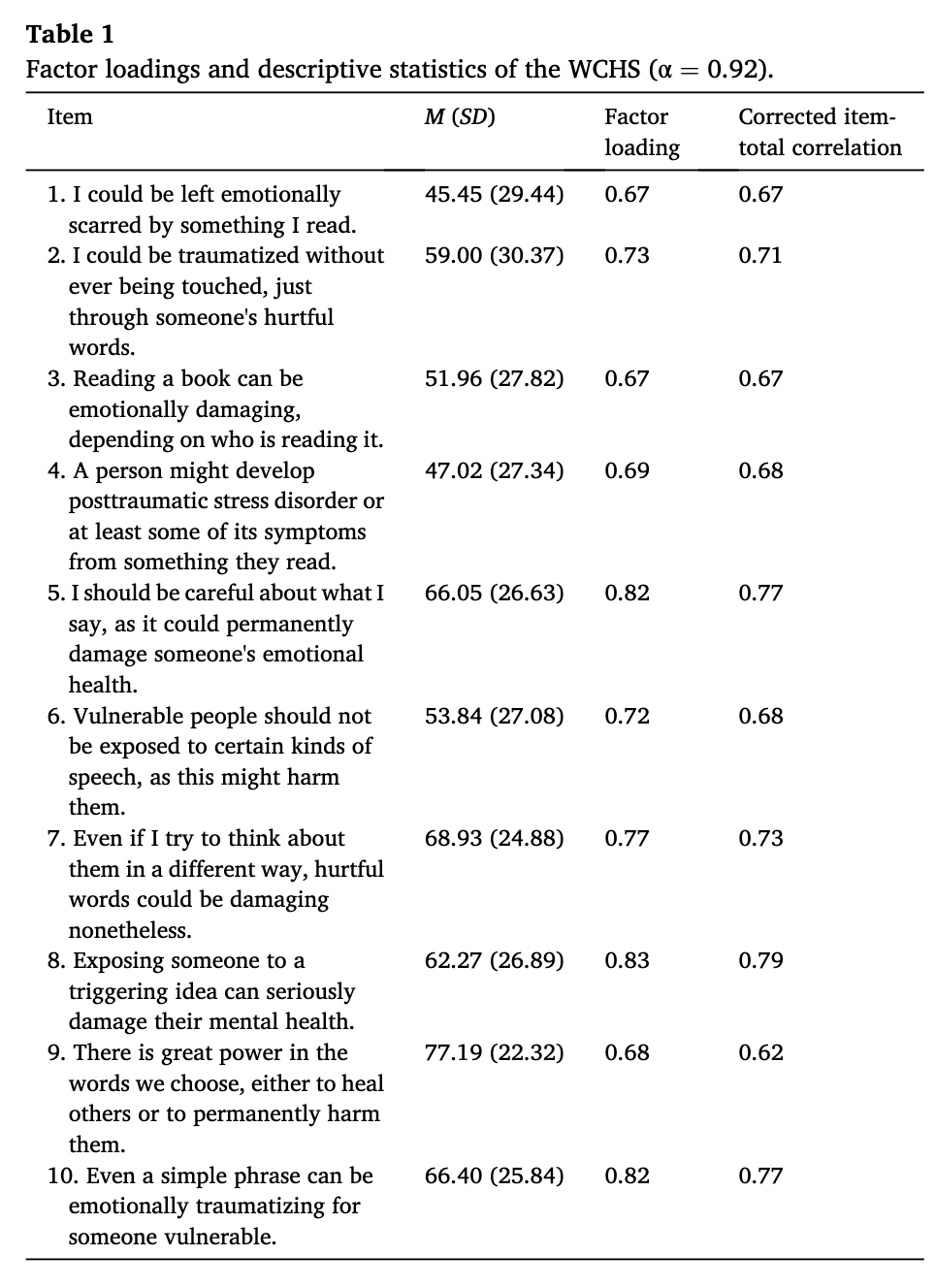
Exposing someone to a triggering idea can seriously damage their mental health.
Even a simple phrase can be emotionally traumatizing for someone vulnerable.
Vulnerable people should not be exposed to certain kinds of speech, as this might harm them.
If you found yourself agreeing (or disagreeing), you’d likely score high (or low) on the Words Can Harm Scale (WCHS), a 10-item scale that my co-authors and I developed to measure the belief that words can cause lasting psychological harm.
And according to our new study in Personality and Individual Differences, knowing your score on this measure gives us an idea of where you likely fall on these other issues:
Whether professors should give trigger warnings before discussing potentially distressing topics in class.
Whether it’s important to silence people who voice problematic or illegitimate political views.
Whether you get anxious or angry when people use politically incorrect language.
You can read the full Words Can Harm Scale below. Next to each statement is the average level of agreement from our nationally representative sample of 956 U.S. adults, on a scale from 1 to 100 (50 = “neither agree nor disagree”, 75 = “somewhat agree”, 100 = “strongly agree”).
Why Measure the Belief that Words Can Harm?
How we respond to negative speech depends partly on whether we view it as harmful versus merely incorrect, offensive, controversial, distressing, or unpopular. Should schools remove books that parents deem sexually explicit or racially divisive? Should social media platforms ban users who post hateful opinions? Your answers probably depend on whether you think words can harm.
Many people feel strongly that words can harm, including some psychologists. Lisa Feldman Barrett argues in a NYT Opinion piece that “if words can cause stress, and if prolonged stress can cause physical harm, then it seems that speech — at least certain types of speech — can be a form of violence.” She goes on to suggest that universities are sometimes justified in barring speakers who voice harmful ideas.
Others counter that by stretching the concept of violence to include negative speech, we’ve created an infantilizing culture of trigger warnings, microaggressions, and safe spaces that coddles young people rather than teaching them to engage with opposing viewpoints.
The goal of the Words Can Harm Scale is not to settle these debates but instead to help understand them. People likely vary in their belief that words can harm, and knowing where someone stands might tell us other interesting things about their personality, demographics, well-being, and the related beliefs they are likely to hold.
And that’s exactly what we found. People who scored higher on the WCHS tended to be younger, female, non-White, and politically liberal. Believing that words can harm was associated with some ostensibly positive traits, like self-reported empathy and intellectual humility, but also with support for censorship and moral grandstanding — the tendency to use one’s moral beliefs to gain status over opponents.
Maybe most striking was that the more strongly people believed that words can harm, the worse their mental health tended to be. They reported more anxiety and depression, lower resilience, greater difficulty regulating their emotions, and viewed themselves and others as especially vulnerable to trauma.
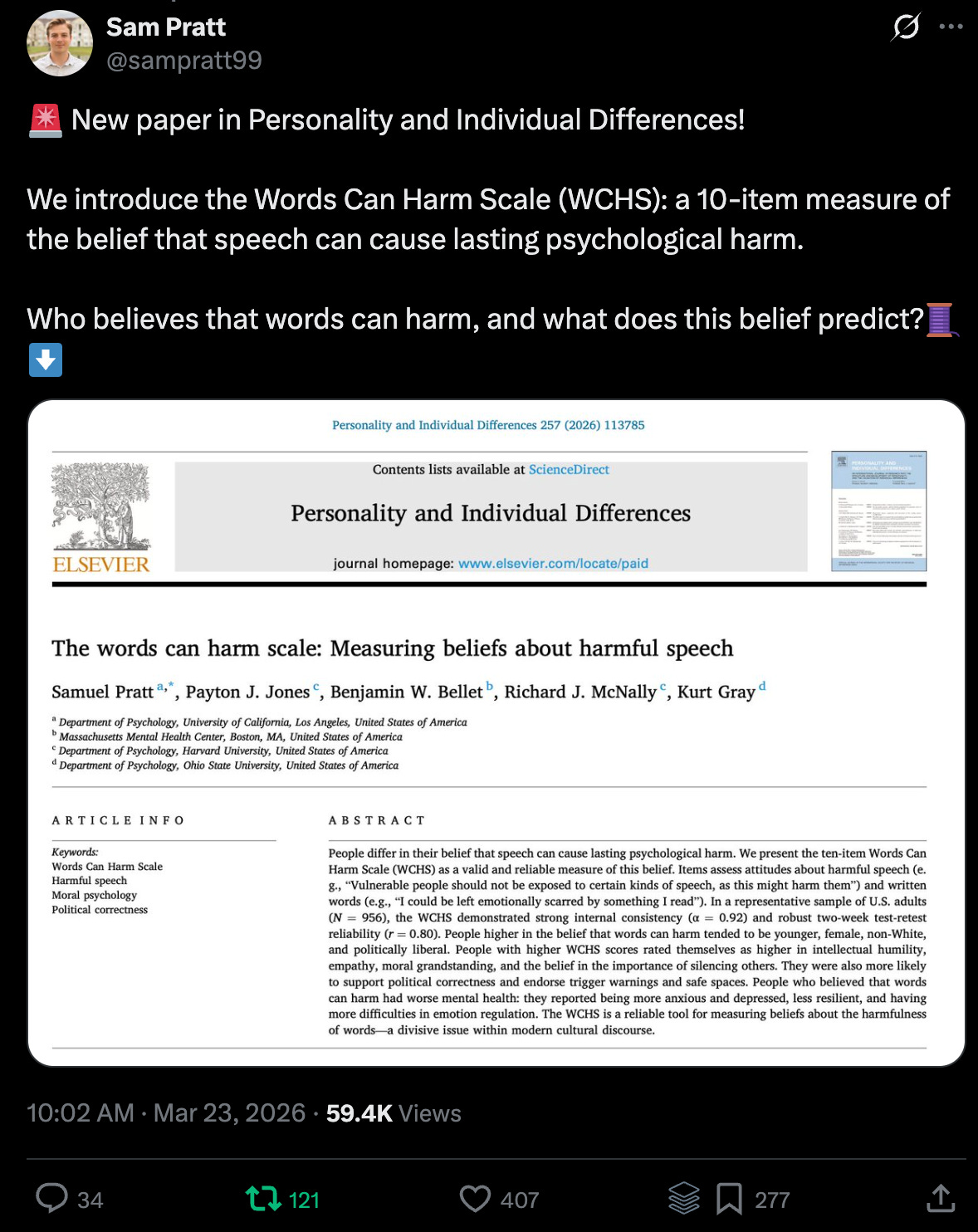
I thought our paper was pretty straightforward — we developed a questionnaire and looked at what other measures it correlates with. But when I posted about it on X, it got a lot more views than I expected and also upset a lot of people. So I thought I’d share some reflections on the challenges of studying people’s deeply held beliefs and clarify what the study does and does not show.
The Dissenters
Some people assumed that by creating a scale to measure the belief that words can harm, we were arguing that words can’t harm (“it’s just a belief”). This upset them because they saw us as minimizing the suffering of people who feel traumatized or hurt by negative speech.
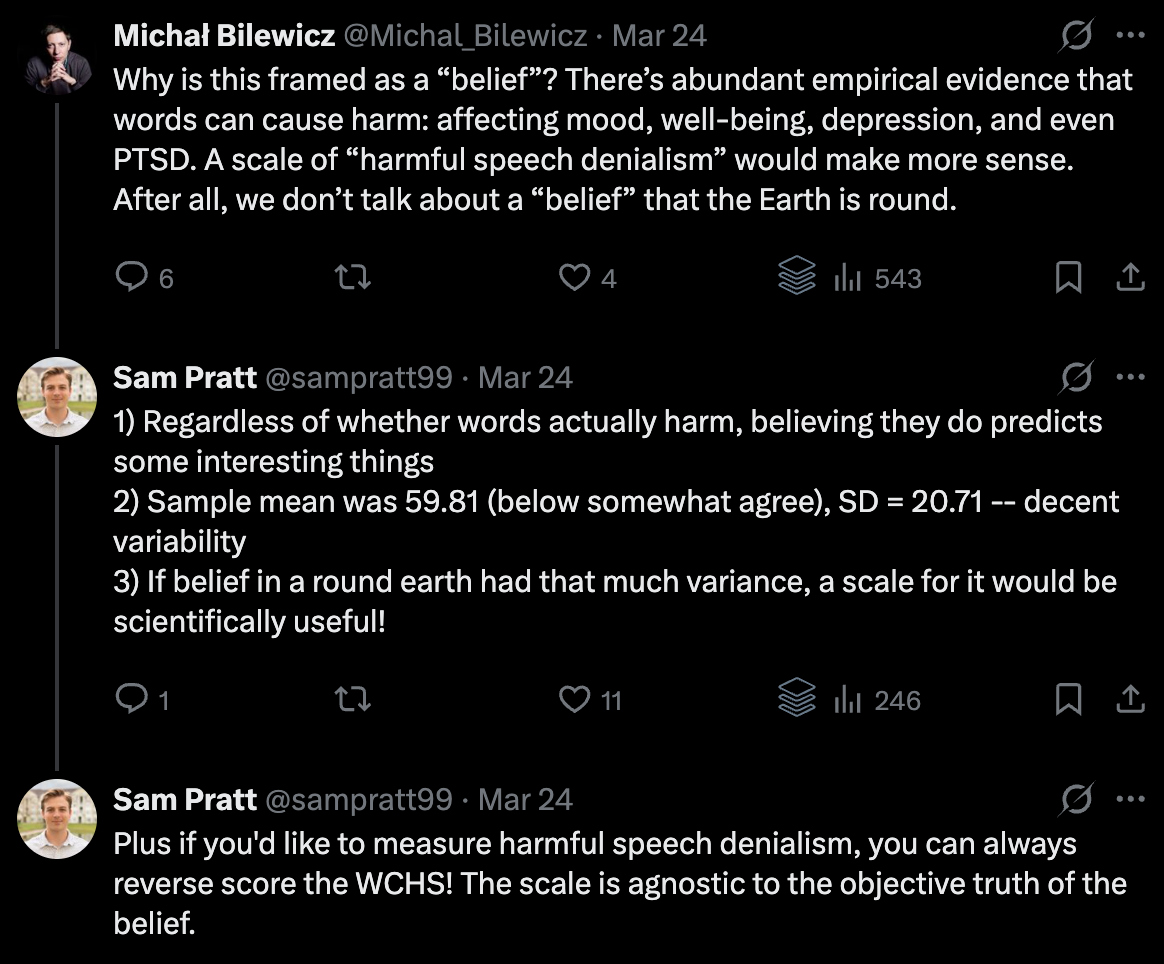
This is a strange assumption. Creating a scale to measure a belief does not imply anything about whether the belief is true. There are scales that measure the belief in climate change, belief in God, belief in free will, belief in a just world, and belief in conspiracy theories. All of these scales, including the WCHS, are anchored by “strongly disagree” at one end and “strongly agree” at the other to represent the full range of opinions. In order to study something we need a way to measure it, and researchers can use our scale regardless of whether they believe that words can harm.
Personally, I do think that words can have real psychological power. People said some pretty mean things about the paper online, like one guy who quote tweeted it and called me the “biggest r*tard on twitter.” That made me feel pretty lousy.
On the other hand, a psychology professor complimented the statistics in the paper and told me that I’m going to go far. That genuinely made my day. If I were to complete the WCHS, I would agree pretty strongly with statement #9 “There is great power in the words we choose, either to heal others or to permanently harm them.”
The Proponents
A lot of people also loved our scale, but for the wrong reasons.
Some people read the list of correlations and concluded that anyone who believes words can harm must be woke, deluded, fragile, and mentally ill. They liked the scale not because it provides a useful scientific tool, but because it confirmed their prior stereotypes and provided fuel for their political talking points.
There are a few things to say about this.
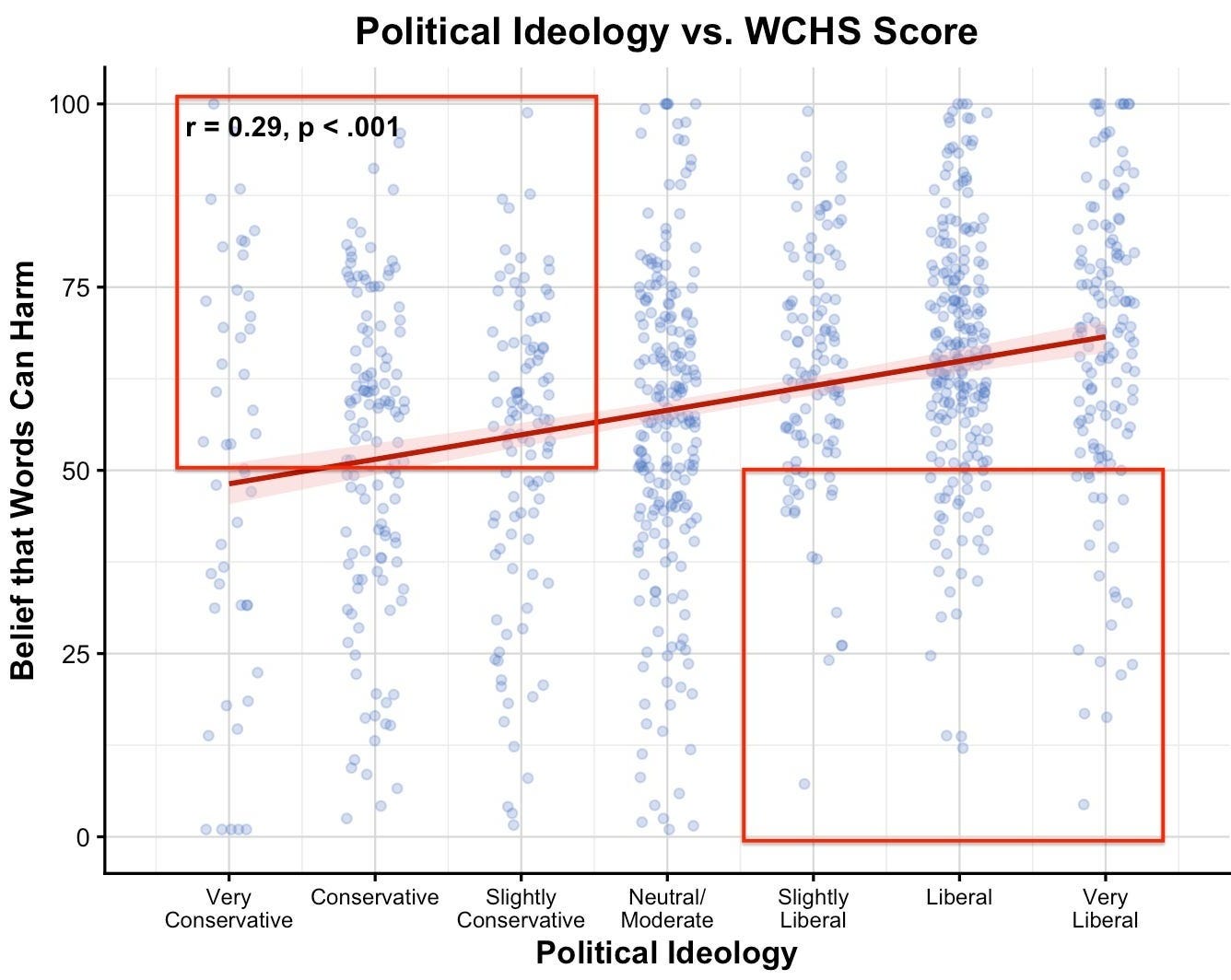
First, the political differences are smaller than you might expect. We observed a correlation of r = 0.29 between the WCHS and liberal political ideology, which is a moderate association. Liberals had higher WCHS scores on average, but there were also plenty of conservatives who believed that words can harm (top left box) and liberals who believed that words can’t harm (bottom right box).
We get a similar picture when we look at WCHS scores by political party affiliation. Democrats were highest in the belief that words can harm on average, but they weren’t as different from Republicans and Independents as I’d expected. All three groups had average scores above the scale midpoint, with wide distributions. So it’s not that liberals are “snowflakes” who uniquely think that words can hurt them. Across the political spectrum and within each party, people disagree with each other about the extent to which words can cause lasting psychological harm.
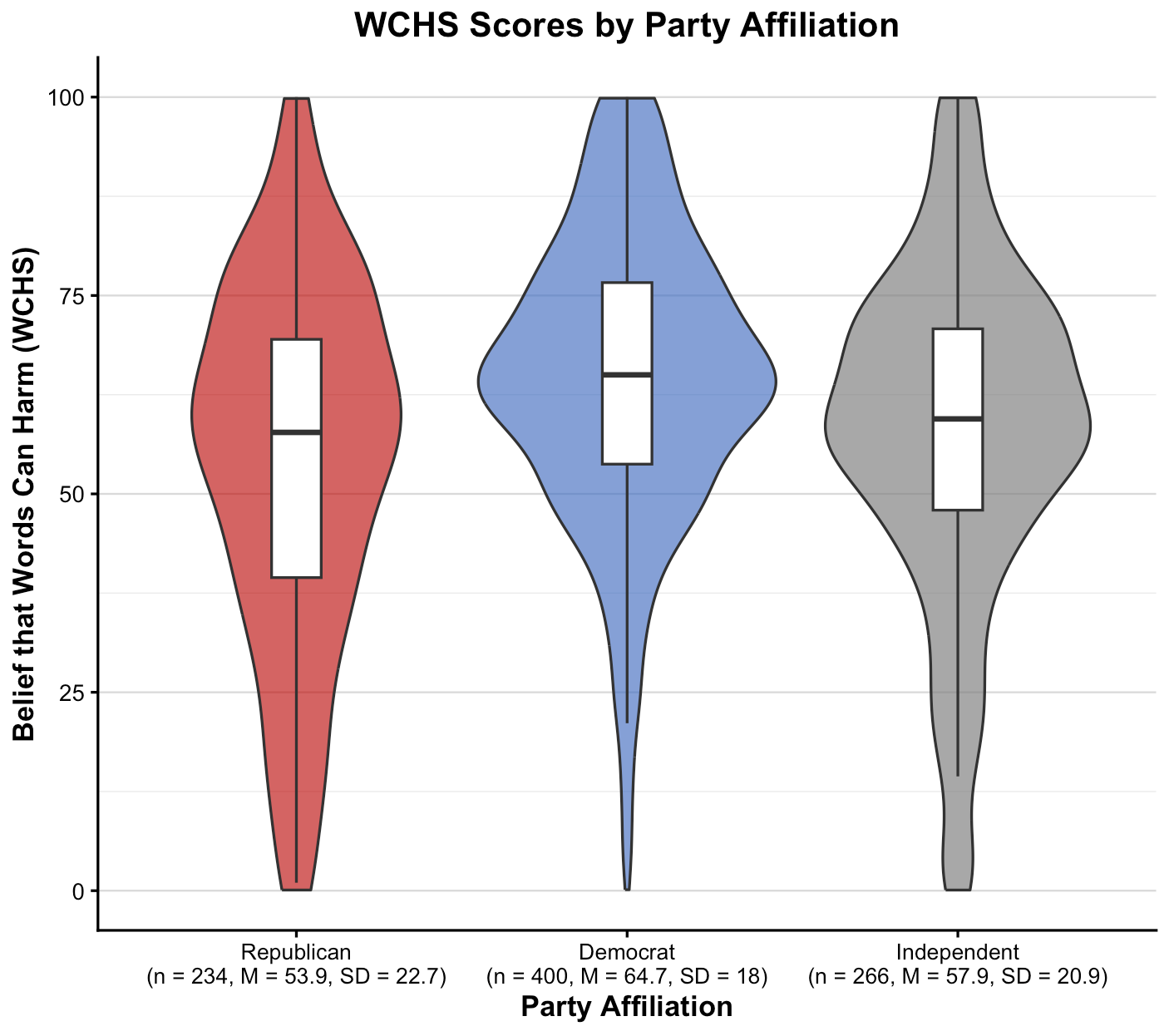
Finally, many people eagerly concluded that believing words can harm is a form of mental illness or a product of emotion dysregulation. Here’s what I’d say about the mental health findings: our study raises interesting questions about why the WCHS is consistently associated with worse mental health, but correlations alone can’t tell us why. We offer a few possibilities in the paper:
People who are more often targeted by negative speech — like women and racial minorities — may feel more hurt by speech and develop a belief that words can harm from experience.
Believing that words can harm may contribute to poor mental health, for example by causing people to interpret language negatively (a self-fulfilling prophecy).
Both could be true: negative experiences with speech lead people to believe that words can harm, which in turn worsens mental health.
The belief that words can harm and poor mental health could both be byproducts of a third variable, like neuroticism.
Conclusion
Studying people’s deeply held beliefs is a funny thing. No matter how unbiased you try to be, you typically end up upsetting people on both sides, because each assumes your agenda is against them. But that shouldn’t stop us from doing the research. To understand the roots of our deepest disagreements — like whether words can harm — we need scientifically valid ways of measuring these beliefs. That’s what the Words Can Harm Scale is for. I hope it proves useful for researchers interested in these topics, whether you feel strongly that words can harm or believe that “words will never hurt me.”
I think harm is doing too much unexamined work in this discussion. It is an unstable reference, a morally saturated catch-all that slides between injury, offence, distress, and symbolic discomfort as though these formed a single obvious category.
So when we ask whether words cause harm, we may already have conceded too much. The question assumes that harm is a stable object that can simply be detected and measured, when in many such cases it is really an interpretation imposed on affective experience through a prior normative framework.
Words can provoke reactions, certainly. They can distress, insult, frighten, or humiliate. But whether those reactions are to be classified as “harm” is not a straightforward empirical matter. It depends on evaluative assumptions that are themselves contestable.
So I would resist treating harm language as neutral description. In many contexts it functions more as moral rhetoric than as a precise analytical category.
Thank you for your thoughts on this topic, especially given the importance and necessity of free speech for a functioning society. Your presentation of the relationship between the belief that words are harmful and political ideology is very interesting and is not something I have encountered before, so definitely hope to look more into this. Thanks again and I look forward to more from you in the future